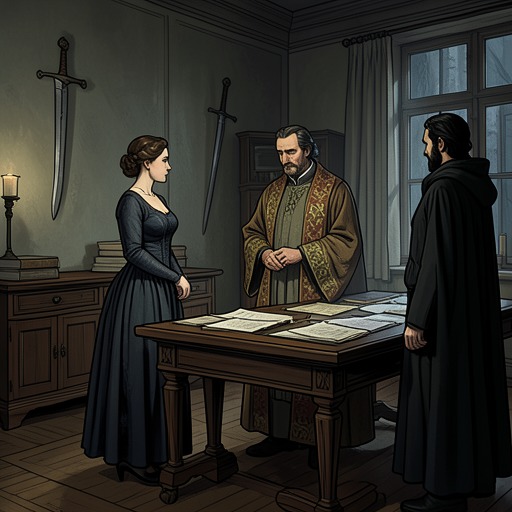
Parlement of Paris inquiry into the Carrouges–Le Gris case
The Last DuelThe Parlement of Paris inquiry into the Carrouges–Le Gris case transformed Marguerite de Carrouges’s allegation against Jacques Le Gris into a public contest involving royal officials, noble networks, and competing claims to credibility. After more than two months of examination, the Parlement did not determine what had happened: on September 15, 1386, it authorized a trial by combat. That decision moved the unresolved question from testimony and investigation to a duel whose result would be treated as judgment.
The allegation and the problem of proof
The case concerned Marguerite de Carrouges’s alleged rape, an accusation made against a squire who was favored by Count Pierre of Alençon and known at the royal court. Marguerite’s position made the prospect of seeking justice especially precarious. Her father’s treason had left the family under a cloud, and her husband, Jean de Carrouges, was one of the count’s troublesome vassals. Le Gris, by contrast, could expect a friendly hearing in the count’s court at Argentan. The allegation was difficult to prove, while the parties entered the dispute with unequal access to influence and protection.
Le Gris had warned Marguerite that disclosure could bring scandal and danger. He also suggested that her husband might suspect her of adultery or even kill her. Jean’s jealousy and suspicion were known from their long experience in the court at Argentan, making the threat more than a general warning. Marguerite nevertheless resolved to tell her husband when he returned. She committed the day and time of Le Gris’s visit to memory, preparing for the questions she expected from her family and for the public scrutiny that an accusation would bring. Jean returned from Paris around January 21 or 22; Marguerite had remained silent until then, including during her mother-in-law’s return from a journey to Saint-Pierre-sur-Dives.
The legal setting further complicated the case. Le Gris was a cleric in minor orders and could claim benefit of clergy, potentially transferring proceedings from a secular court to a church court. Meanwhile, the norms imposed on aristocratic wives made Marguerite’s sexual reputation central to the dispute: noblemen valued chastity in their wives as a safeguard for legitimate inheritance, although the same standards did not necessarily govern their own conduct. Her testimony therefore confronted not only the difficulty of proof but a system that closely scrutinized a woman’s honor while leaving her vulnerable to suspicion.
A widening investigation in July and August
As the Parlement’s inquiry continued through July and into August, new interventions enlarged the case rather than resolving it. At the end of July, Guillaume Berengier reached Paris with sealed letters for the Parlement from Guillaume de Mauvinet, the bailiff of Caen. Mauvinet also instructed him to deliver additional information orally, described as secret matters not to be put in writing. The letters and the unwritten report have not survived. Their contents remain unknown, but the connection was significant: Mauvinet was the official before whom Dame Nicole had appeared at Saint-Pierre-sur-Dives on the day of the alleged crime. The book presents the new dispatches as a further effort to damage Jean’s appeal by discrediting Marguerite’s testimony, not as proof that the attempt succeeded.
The Parlement also returned to the case of Adam Louvel, Le Gris’s alleged accomplice. Louvel had been arrested and questioned months earlier on Count Pierre’s orders, but the same verdict that exonerated Le Gris had absolved him. On July 20, the Parlement demanded guarantees that Louvel would appear in Paris. Two days later, he appeared before Charles VI at the Château de Vincennes. There, Thomin du Bois, a squire and cousin of Marguerite, accused Louvel of attacking her and threw down his gage of battle. He demanded a duel, and argued that Louvel’s refusal to fight after denying the accusation should be treated as an admission of guilt. The challenge raised the possibility of two simultaneous duels, one involving Jean and Le Gris and another involving Thomin and Louvel.
Louvel asked for a jour d’avis, a period in which to consult legal counsel, and received until July 24. The Parlement’s records show no further action on that date. By August 20, however, the inquiry had widened again: Louvel’s son Guillaume, Estiene Gosselin, and Thomas de Bellefons were taken into custody for examination in connection with the pending wagers of battle. The record describes Jean and Thomin as plaintiffs on one side and Le Gris and Louvel as defendants on the other, suggesting that the two challenges had been joined into a single proceeding.
Louvel, by then confined in the Conciergerie prison attached to the Palais de Justice, was ordered to be questioned under torture. Judicial torture was increasingly used as confession became more important to determining guilt, even as ordeals and duels receded. Jean Le Coq’s diary records that Louvel and a maidservant said to have been at the Carrouges residence that day were questioned; neither confessed. The inquiry also reached Jean Beloteau, a recently widowed squire whose account formed part of Le Gris’s alibi. The bailiff of the bishop of Paris arrested him on suspicion of raptus, a term that could mean abduction or rape.
The court during a royal absence
The investigation proceeded amid competing political priorities. Charles VI and his uncles left Paris for Flanders as part of preparations for a planned invasion of England. The king had approved a large expedition and vowed to set foot on English soil before returning to Paris. With the royal party away, the Parlement resumed its work, including the Carrouges–Le Gris inquiry. Jean and Le Gris remained prisoners of Paris but could move about the city; they were required to attend the Palais de Justice whenever summoned.
Marguerite, meanwhile, was at least eight months pregnant. She was waiting both for the birth and for the court’s decision in unfamiliar surroundings, under the strain of an inquiry whose outcome would determine her future as well as her husband’s. The surviving record does not disclose what she privately feared about the pregnancy. It does show that the investigation continued while her physical circumstances narrowed her freedom of movement and the legal process offered no settled conclusion.
Le Coq’s diary preserves the uncertainty surrounding the case. He noted that some people said Le Gris would not confess because doing so would bring scandal upon his sons and friends, particularly after Count Pierre had sworn to his innocence. That account raised the possibility that Le Gris’s position was shaped by pressure from those around him, and Le Coq’s observations suggest that the lawyer himself had doubts. Yet proximity to the proceedings did not give him certainty. His final assessment acknowledged that the truth remained unknown. The inquiry thus accumulated testimony, arrests, and political claims without producing evidence that could settle the central dispute.
The September decision
On September 15, more than two months after the inquiry began and eight months after the date of the alleged crime, the Parlement summoned Jean and Le Gris to hear its decision. With Charles VI and his uncles still away, Arnold de Corbie, the court’s first president, presided in the Grand’ Chambre. The two men appeared with their lawyers, supporters, and six noble pledges each. Marguerite may have been absent because she was near the end of her pregnancy.
A decision to authorize combat was unusual. The Parlement had not authorized a duel in an alleged rape case since 1354, and it had rejected numerous appeals for judicial combat in the intervening decades. The court’s order therefore did not amount to a routine response to the evidence. Its decision may also have reflected the political difficulty of choosing between two well-known royal servants. Both sides had powerful supporters, and public opinion in Paris was divided. With the king and his uncles absent, granting Jean’s request could allow the court to avoid a direct judgment that might deepen the controversy and leave the ultimate determination to God.
The Parlement ordered a trial by combat between Jean de Carrouges, knight, and Jacques Le Gris, squire. The duel was initially appointed for November 27, at least forty days after the ruling and more than two months away. The delay meant that Marguerite was expected to give birth before the combat took place. The king later postponed the duel for a full month so that he could witness it after returning from Flanders.
From investigation to public ordeal
The ruling redirected the case from an inquiry into testimony toward a public ritual of combat. The planned event at Saint-Martin’s dueling ground was prepared for thousands of spectators, with separate viewing stands for the king and high-ranking nobles, other members of the royal court, foreign nobles, ladies, and lower-status townspeople. The arrangement made rank visible even as the duel was presented as a means of settling a dispute that the court had not resolved through evidence.
The ritual also demanded strict control of the audience. Heralds announced prohibitions on weapons, standing in ways that obstructed the view, and speaking or gesturing during the fight; violations could bring severe penalties. Chroniclers described spectators watching in silence. The king would preside, and the combatants’ bodies would stand in for a judgment the inquiry had been unable to establish. After the duel, once Jean de Carrouges asked whether he had done his duty, the crowd answered together, breaking the silence that had governed the contest. The inquiry’s consequence was therefore more than a scheduled fight: it converted unresolved testimony into a public verdict whose authority depended on the spectacle and its result.